


Parvin Salajeqeh, professor, poet, and critic, mentioned that the main feature of Akhmatova’s poetic skill was her uncomplicated depiction of the 20th century.
“The themes of Akhmatova’s works were ‘love’ and ‘separation’ which can be seen as a philosophical expression of her surroundings during her life in the Soviet Union. Akhmatova’s poems were rooted in her personal bourgeoisie and romanticism which later turned into a type of social romanticism. Her works were based on the experiences which she shared with the common people, she did not agree to writing at the order of the ruling government,” Salajeqeh added.
Ahmad Puri, who translated Akhmatova’s work into Persian, said that the atmosphere surrounding an artist provides a suggestion for the creation of a work and the reader may enjoy knowing a poem’s background. However a poem can be interpreted more freely if its setting remains unknown.
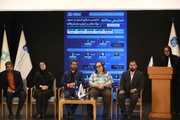
During the ceremony Ali Behbahani, scholar and translator of Russian literature, explained that Akhmatova was a member of the Acmeist school of poets and named her for her colloquial style as the founder of modern art in the literature of The Soviet Union.
Acmeism is a school of early 20th-century Russian poetry whose practitioners were strongly opposed to the vagueness of symbolism and strove for absolute clarity of expression through precise, concrete imagery.
After the ceremony Pegah Ahmadi, poet and literary critic, recited some of Akhmatova’s poems.
The ceremony was set up with the collaboration of Cheshmeh, the publishers of Akhmatova’s works.
Anna Akhmatova was the pen name of Anna Andreyevna Gorenko who was born June 11, 1889. Her works include: Belaya staya (1917; “The White Flock”), Podorozhnik (1921; “Plantain”), and Anno Domini MCMXXI (1922) which have been translated into various languages. At her death on March 5 1966 she was recognized as the greatest woman poet in Russian literature.
SB/MA
END
MNA

















Your Comment